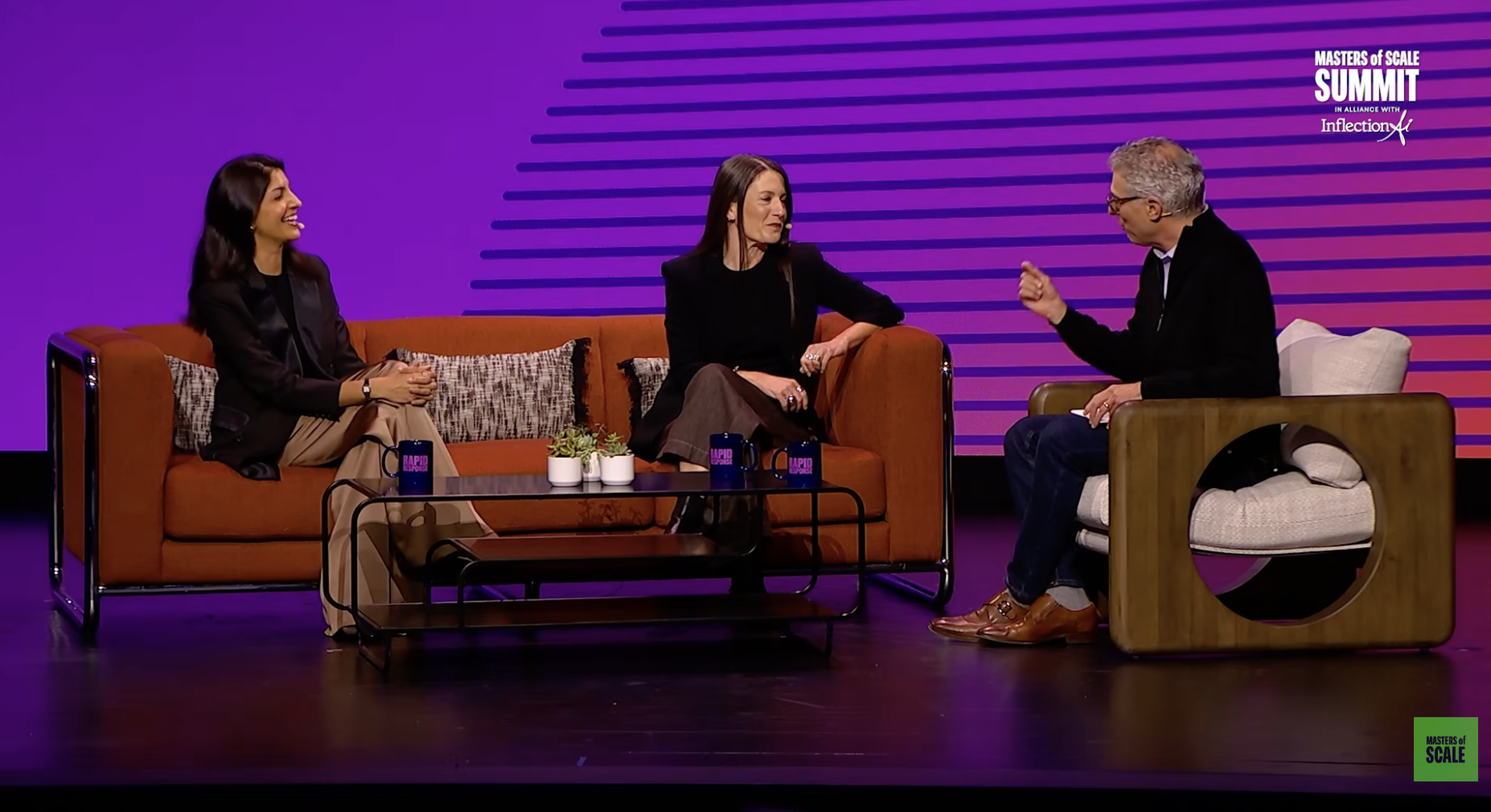
Bob Safian frames Tubi CEO Anjali Sud and e.l.f. Beauty president Kory Marchisotto as kind-hearted disruptors who win by serving audiences other brands tend to overlook.
Marchisotto lays out e.l.f.’s four-part playbook: see the overlooked consumer, challenge conventions, scale in the white space, and open a new path others can follow.
Both leaders say bold marketing and creator platforms work best when they create zero distance from fans, whether through Super Bowl stunts, TikTok feedback, or creator-led storytelling.
As their brands grow, Sud and Marchisotto argue the edge comes from staying scrappy, tying representation to business results, and using AI to lower barriers without losing the human center.
Note: Transcripts are automatically generated from episode audio, and are not fully corrected for spelling, grammar, and formatting.
ANJALI SUD: We as consumers tend to think if something is free, there’s a catch. It must mean it’s low-quality content or the experience is bad. That is the battle we have been trying to fight.
KORY MARCHISOTTO: What Tubi and e.l.f. do uniquely is see the ones that everybody else misses. We’re a symbol of the overlooked and a champion of the underdog, and they roar with courage when you find them.
BOB SAFIAN: That’s Anjali Sud, former CEO of free streaming service Tubi, and Kory Marchisotto, president of e.l.f. Beauty, recorded live at Masters of Scale Summit in San Francisco in October, talking about the bold risks that have transformed the brands from down-market underdogs into major industry disruptors. Anjali and Kory share hard-earned lessons from TikTok to the Super Bowl to e.l.f.’s So Many Dicks campaign. Two weeks after this recording, Anjali announced that she’s taking over as CEO of SiriusXM, which underscores what she achieved at Tubi. So let’s get to it. I’m Bob Safian, and this is Rapid Response. Please welcome the CEO of Tubi, Anjali Sud, and the president of e.l.f. Brands, Kory Marchisotto.
MARCHISOTTO: Hello.
SAFIAN: All right, welcome to my living room.
SUD: It’s beautiful. Thank you.
SAFIAN: I have to say that when I was thinking about the two of you and your brands, there’s kind of this subversive thread that runs through both of your businesses, that you’ve targeted consumer communities and constituencies that might otherwise be overlooked, right? And in doing that, you’ve ended up attracting customers even among the more privileged, let’s say, right? It’s a little bit revolutionary. Do you guys talk about this? I mean, you two know each other.
SUD: We do
MARCHISOTTO: Do you talk about this?
SUD: We coordinated these outfits. No, we didn’t. I think we talk about it quite a bit, and I won’t steal Kory’s words because she says it so well, but we met probably a couple years ago. Tubi is trying to democratize storytelling, and e.l.f. is doing what they’re doing. We really did feel that connection of trying to approach a category in a different way, but not different just to be different, different in a way that serves the consumer and really puts them first. I think we’re both benefiting from seeing that in our businesses.
SAFIAN: Yeah, Kory, do you think of yourself as a revolutionary? Are you revolutionizing the world of beauty?
MARCHISOTTO: I don’t know if I would say revolutionary.
SAFIAN: Uh-huh.
MARCHISOTTO: We call ourselves at e.l.f. bold disruptors with a kind heart. It’s a really important way to frame things because when you know who you are and you know what you’re up to, then you attract others who are doing the same. Anjali is a bold disruptor with a kind heart. And that distinction is really important because when you think about a lot of innovative companies, they’re doing bold disruption. Then there are kind hearts, right? And there are many kind hearts. Bold disruptors, there are few. The intersection of those two things is a unicorn because you’re fearless and heart-full.
Most revolutionaries can be heartless. So that’s the magic of e.l.f., that we’re bringing those two worlds together in what I call unicorn territory.
Turning free and affordable into a strength
SAFIAN: So I have to admit, Anjali, that when Tubi first hit my consciousness, I had this vague sense of this down-market free streaming service that no one I knew used or admitted to using. What was your initial sense of Tubi, and how did you think about moving from outsider status to today, with 110 million or more users?
SUD: Yeah, I had a similar experience before I joined Tubi. I think even though Tubi’s been around for more than a decade, fully committed to this mission of free streaming and platforming more stories, we as consumers tend to think if something is free, there’s a catch. It must mean it’s low-quality content or the experience is bad. In some ways, I think that is the battle we have been trying to fight and prove to consumers. But it’s more of a testament to the market that we’re in, that as consumers we almost can’t accept that, of course, you can have a wonderful experience. Of course, you can get the best of Hollywood and the best of the creator economy and original content, and it can be free, and it can be great. For me, I liked that, in some ways, Tubi was underestimated because the product was good. The minute I could see that we were doing something that, if anyone would try it, they would enjoy it, I mean, that’s a wonderful place to try and disrupt from. And the key has just been that we never lose focus or sight of that, and we stay committed to it.
MARCHISOTTO: Can we just applaud 110 million monthly actives? We just throw numbers around like it’s no big deal. That’s a really big deal.
SAFIAN: All right, well, I want to throw out some numbers about e.l.f. Beauty, okay? Because the thing is, this is a brand that’s built on affordability at a time when the beauty business is about premium and exclusivity. That kind of is what has defined the market. And you guys talk about prestige quality at drugstore prices, which can sound like a Mad Men slogan that’s not going to hold up in real life. But e.l.f. has been growing for 29 consecutive quarters.
MARCHISOTTO: Yeah.
SAFIAN: I’m a quarter behind. $2 billion in annual sales, right? I mean, what was everyone else missing that you guys saw or did?
SUD: Yeah.
MARCHISOTTO: So I would position that as making the inaccessible accessible, which is exactly what Tubi is doing as well. There’s a lot more in common in businesses that are serving the underserved than not. And if I had to break this down into a four-part blueprint for the audience, the starting point is the consumers we see. What Tubi and e.l.f. do uniquely is see the ones that everybody else misses. We’re a symbol of the overlooked and a champion of the underdog, and they roar with courage when you find them. The second part is you’ve got to challenge conventions. We’re both in businesses that have built hundreds of years of behemoths, and the reality is you can’t take them on. I can’t play your game. I’m not going to win at it. L’Oreal’s a $45 billion company.
SAFIAN: Yes.
MARCHISOTTO: They’re incredible, a formidable opponent. I love what they’re up to. You keep doing that. I’m going to come over here and do this. I’m going to find a new way. I’m going to challenge conventions. I’m going to change the conversation, and I’m actually going to build a different game. Then the third part is you’ve got to scale the business in that white space, right? Who are these people we found? What do they desire, and what is available to them? You find what is not. That’s the gap between what is available and what they actually desire, and then you scale the business in that space, which then takes you to the fourth piece, which is: I have now opened the doors for others to follow because they see that there’s another path.
A four-part blueprint for overlooked audiences
SAFIAN: Right. Well, it’s not just that initial community that gets attracted by what you’re delivering. I mean, you’ve both made creative moves to demonstrate your differentiation as brands, including some unconventional Super Bowl ads, which I think we might have some visuals of: Tubi’s bizarre cowboy hat head spot, and e.l.f.’s Melissa McCarthy telenovela spoof
When you guys thought about it, is the Super Bowl a way to reach scale or a way to demonstrate scale?
SUD: Well, I think for Tubi it was both. Generally, our brand, we’re fans of the fans, and our fans love everything, and they’re eclectic and sometimes a little unhinged.
SAFIAN: A little strange.
SUD: And we embrace that. I think for us, it’s about reflecting that we see and get our fans. So there is a part of it that’s reach. I think in Tubi’s case, two years ago, we actually streamed the Super Bowl for free. It was the most streamed Super Bowl in history, and we were able to offer millions of Americans free access in 4K at the lowest latency, just a great experience. And so for us, it’s also a way to show that it is possible for premium entertainment to not come with a huge price tag, and it is possible to get a wonderful experience without prices increasing all the time. We just wanted to bring that. So for me, the Super Bowl has been both. It’s been this way to reach and connect with our fans, but also a way to expose many more people to the potential of the platform.
MARCHISOTTO: Yeah. If you go back to the four-part blueprint I said before, the first one is: Where are they? And when you think about the big game, there’s 120 million viewers, right? We studied every single commercial. Less than 1% were talking to women. There they are, showing up as 50% of the audience, and nobody’s talking to them. That’s why we’re there. And no beauty brands had ever shown up in that space before, and that was the challenge to convention.
It’s not because nobody has done it before that we shouldn’t do it. Let’s scale our own brand in this space in a meaningfully differentiated way. And we didn’t just show up at our first Super Bowl quietly.
SAFIAN: No, it was not quiet.
MARCHISOTTO: We roared with courage with Jennifer Coolidge. So we didn’t just put a woman at the center. We put a 60-year-old woman at the center, and it was so unbelievably well received. The entire floor of our business, all of our metrics, blew up in terms of unaided awareness, likability, all the things you could imagine. We said, “Okay. We just actually tickled something that nobody else has.” So we came back the second year with Judge Judy, an 80-year-old woman. If you see what we’re doing, it’s not just about showing up for the underserved. It’s about telling them that you belong here. We see you, and we’re making a place of belonging where nobody else did.
Why bold marketing works at mass scale
SAFIAN: You guys have also both leaned into TikTok.
I know, Corey, your CEO, Tarang Amin, told me that you pressed him to do TikTok Live, to talk directly to customers, something you call zero distance. And Anjali, you’ve tapped TikTok to find characters for shows, a partnership called the Creatorverse. What does TikTok offer you as a platform that helps you differentiate?
MARCHISOTTO: So our CEO, Tarang Amin, definitely didn’t say I pressed him. He said I torture him. He is so tortured every time I put him on TikTok Live. Why do we love it? And it’s not just about TikTok Live. It’s any place you can live-stream with zero distance between you and the community you serve. What happens is, in a lot of companies, there’s great distance. The CEO and the C-suite sit in an ivory tower, and it’s everybody else’s job in the company to serve the consumer. I’m like, “No. It’s our job, from our position, no matter where we sit.” So the best way to do that is, how do we get in front of the greatest number of people in the shortest amount of time? Why am I going to sit in a room and brainstorm with a bunch of folks what the consumers want? Why not ask them directly?
SAFIAN: It sounds so logical.
MARCHISOTTO: So logical.
SAFIAN: But I could have my own meeting and just talk to my own people.
MARCHISOTTO: The first time I brought our CEO on a TikTok Live, 15,000 people showed up. He was so terrorized by their demand for bronzing drops that we didn’t have, and that were in the pipeline, he literally left the TikTok Live and said, “Okay, I’m going to go get it,” ran down the hallway, went to the innovation team, and said, “I need bronzing drops now.”
We fast-tracked the timeline and got it to market in six months when it had been planned on the calendar for 12 to 18 months later. So that’s the kind of power you have when you ensure zero distance. And one other example I want to add, because this is super powerful: We asked our community, “What do you want to hear from your brand? You want to spend time with us. We created a place of belonging. What do you want to hear from us?” The number one thing that kept coming back was career advice, and the second thing was financial literacy.
This is not a beauty brand anymore. This is a trusted friend. We talked a lot about trust yesterday. This is trust. So what did I do? “Mandy Fields, CFO, I’m going to need you to come on a Twitch livestream and teach financial literacy.” 110,000 showed up.
SAFIAN: Wow.
MARCHISOTTO: 110,000. So when you open the aperture and you actually widen the relationship and extend the limits of where you think you’re standing, it opens up a completely new pathway for a relationship between you and the people you serve.
SUD: And I think it’s so true, that zero-distance relationship with fans. At Tubi, we routinely greenlight shows and movies or platform stories because of what our fans talk about. But I think what’s even more exciting is going from listening to our fans and connecting with them to giving them a voice to be the creators of their stories.
That’s a whole other area we’re seeing now. What’s great about working with creators is that, all day, every day, all they do is serve their fans, right? They’re constantly creating content based on what their fans want. And historically, if you look at Hollywood, it’s a very different studio system. There’s this really interesting thing happening right now where these two areas, it’s not that it’s a battle or a shift, it’s a bridge.
We’re seeing that. There’s a TikTok influencer named Noah Beck who had never done a movie before, and he became the star and producer of a Tubi original franchise called Sideline that’s had 20 million views. We did not do marketing. It was the fans clipping scenes and sharing it. And now he’s starring in Baywatch. Right? So you’re seeing this transition where TikTok and these platforms, because they’re so close to the fans, are empowering. And we can help empower those fans to not just be heard, but to actually be storytellers and participate.
In a way that I don’t think we’ve seen in Hollywood before.
Using creator platforms to stay close to fans
SAFIAN: Cory and Anjali seem to revel in making unconventional choices. So how do they keep that edge as they grow from disruptors to established players? We’ll talk about that and more after the break. Stay with us. Before the break, Anjali Sud and e.l.f.’s Kory Marchisotto talked about operating as underdogs to disrupt industry leaders. Now they talk about what it takes to stay bold as you grow, including Tubi’s positioning inside Fox and e.l.f.’s provocative So Many Dicks campaign. Let’s jump back in. Tubi is part of Fox, so that traditional studio is right next to you. Your offices are on their lot, right?
MARCHISOTTO: Yeah.
SAFIAN: Is that awkward?
SUD: It certainly could be, and what’s been so wonderful is that it has not been. I think Tubi operates very much like a startup still, even though if you look at our scale and size, it’s not just 110 million monthly active users. It’s over a billion in revenue. We’re profitable. And yet, if you were to come onto the lot and work with the Tubi team, we’d feel like a challenger every day.
SAFIAN: Yeah.
SUD: I think we’ve fought really hard to preserve that. At the same time, there are huge opportunities that come when you can be a bridge to Hollywood. The example of streaming the Super Bowl was in partnership with Fox Sports.
SAFIAN: Right, which wouldn’t have been available to you if you were not part of Fox.
SUD: It never would have. We were able to stream World Cup matches and create stories and shoulder content around them, like the docuseries following the players. All of that is because we’re trying not to just exist in the space of Silicon Valley and be that startup disruptor. We see it as helping create that bridge so that we are lifting all boats. This is an industry that can really use that, and I think that’s why you’re seeing the success at the scale we have.
Staying scrappy while scaling inside incumbents
SAFIAN: So Kory, I have to bring up e.l.f.’s So Many Dicks campaign. I think we have an image of that, spotlighting that there are more men named Dick on corporate boards than there are women overall or a bunch of other different groups, right?
SUD: Yep.
MARCHISOTTO: I wish you had the video that says, “So many Dicks,” because that’s actually what happens after this still shot that you have.
SAFIAN: A beauty company wading into corporate governance — this is not something someone would say, “Oh yeah, we’re a beauty brand. Let’s do this.” Why wade into this?
MARCHISOTTO: Okay, I take it you haven’t seen it. This is amazing
SAFIAN: So this is not something that someone would say, “Oh yeah, we’re a beauty brand. Let’s do this.” Why wade into this?
MARCHISOTTO: When you think about opening the aperture and asking yourself what business we’re really in, it’s about liberating access. It’s not just about liberating access to the best of beauty, it’s also about liberating access to equity. Every single e.l.f. is a shareholder, all of them—our coordinators, our front desk, every single e.l.f.—so we create a spirit of ownership. We also liberate access to the highest seats of power, which is the boardroom. When I started at e.l.f., it was probably 10 quarters in when I was like, “This can’t be normal.” This can’t be normal, what I’m looking at: majority female and very diverse. So I did what anybody would do in that moment. I went and asked our investor relations team for some data. I said, “Please tell me, if you studied every single publicly traded company—there are 3,700—is there anybody else whose board looks like ours?” And the answer was shocking. At that time, we were the only one out of 3,700. The only one that was majority female and over 40 percent diverse representation. You have one of two choices in a situation like that: take a victory lap and be like, “Yeah, look at us. We’re great.” Or jolt people into awareness to inspire change so that other boardrooms can look like yours.
SAFIAN: You felt like you didn’t have a choice.
MARCHISOTTO: We did
SAFIAN: You had to share this.
MARCHISOTTO: It was boiling, right? I had the fire in the belly. I was like, “We have to change the game.”
SAFIAN: But this wasn’t proprietary data. This is out there.
MARCHISOTTO: It wasn’t, actually. We had to enter 37,000 names manually into a database, and when we crunched the numbers, what we found is there were more men named Richard, Rich, or Dick than entire groups of underprivileged people. So when we were in our creative brainstorm, we weren’t even looking for the title of the campaign. It was just that moment when somebody was like, “What does the data say?” And they were like, “There’s a lot of Dick in there.” Then somebody else turned around and goes, “Yeah, so many Dicks.” And I was like, “Guys, we’re done here.”
SUD: End scene.
MARCHISOTTO: End scene
SAFIAN: Yeah.
MARCHISOTTO: Obviously, we said, “Well, we could be the beacon of change. Our case is bulletproof because not only does our board represent less than 1% of all publicly traded boards on the NYSE, but we’ve got 30 consecutive quarters of growth to show that there’s real business impact.” When you have a variety of perspectives in the boardroom, it changes the outcome of your business. So it’s good for business, and it’s good for society.
SUD: Amazing.
Why representation matters when tied to results
SAFIAN: Anjali, as a CEO who’s not named Dick
MARCHISOTTO: Yeah.
SAFIAN: How do you respond? Does this echo for you, like, “Yeah, this is my life”? Or do you think, “I just don’t want to think about it”?
SUD: I think it’s so needed and courageous. I have been blessed to be on several public company boards, and I think the thing that has been missing, that Kory and her team are doing so well, is taking the conversation beyond just representation and having voices in the boardroom to impact, because that’s really what this is about.
SAFIAN: Yes.
SUD: It’s about successful businesses and growth and change, and that is, I think, one of the first times we’ve heard that message, which is: It’s not representation and bringing people’s voices into the room just so we can pat ourselves on the back. It’s because we want to succeed. We want to win.
SAFIAN: Yeah.
SUD: Let’s go do the things necessary to win. For me, I think it’s wonderful to see, and it certainly makes me, personally, want to be a champion for a brand like e.l.f.
How AI can lower barriers to creativity
SAFIAN: We only have a couple more minutes, but I am contractually obliged at this point to bring up the topic of AI.
MARCHISOTTO: We challenge conventions here.
SUD: Yeah. We’re happy to challenge that.
SAFIAN: Right?
MARCHISOTTO: We’re happy to challenge that.
SAFIAN: Is there a philosophy about AI that underscores what you’re doing at Tubi? I mean, AI is changing Hollywood and entertainment.
SUD: We’ve actually been using AI and machine learning to personalize experiences for a very long time, and we continue to think there’s so much room. When you turn on your television, most people still spend 15 minutes searching for what to watch, and then you start scrolling on TikTok, and then you give up and move on. Technology, through things like AI, should make that way better.
SUD: On the storytelling side, I’ve spent over a decade trying to help storytellers use technology to lower the barriers to actually get their ideas from imagination to a finished piece that they can put out into the world. I think there’s a ton of opportunity there, helping lower the barriers to creativity and storytelling.
SUD: We do expect there to be more content created. We’re already seeing this. There’s a lot of content out there, and yet there’s this paradox of choice. If everybody’s making content, how do we get them an audience, right? I think that’s where Tubi sees ourselves as being able to help with distribution and try to make sure that every story is worthy of finding its audience. How are we going to help them do that using technology?
SAFIAN: Do you have an AI philosophy at e.l.f.?
MARCHISOTTO: We do, and then I’m going to have a revolutionary answer to that question. Our AI philosophy is human-centered: human first, human last, AI in the center as an enabler of the humans.
MARCHISOTTO: Now I’m going to take a revolutionary place in the five seconds we have left. Because I’m sitting next to a female CEO, I really want to say this because it’s fundamental. Fortune 500 companies: only 10% of CEOs are women. Anjali is a beacon of what’s possible, and all of us in this room need to be the allies and the champions of women who are sitting in the CEO chair because we need to see a lot more of them.
SUD: Wow.
MARCHISOTTO: So I’d like to applaud you.
SAFIAN: Thank you so much.
SUD: Amazing.
SAFIAN: That was great.
MARCHISOTTO: Perfect.
Watch the full conversation on YouTube: https://www.youtube.com/watch?v=oRUlBahdVGU